Essential Eight in practice: a board-ready guide for fast, measurable uplift
Australian boards are being asked to show progress against the ACSC Essential Eight, yet many programs stall because the work feels abstract, the evidence is unclear, and timeframes slip. It does not have to be that way.
This guide translates the Essential Eight into a staged plan with concrete controls, audit-ready evidence, and realistic timelines for SMBs, councils, healthcare, and schools. It highlights common pitfalls, shows how a SOC with Endpoint Detection and Response (EDR), vulnerability management, and disciplined 3-2-1 backup testing closes gaps, and provides a sample dashboard you can take to the next board meeting. With End of Financial Year planning approaching, it is the right moment to secure budget and set a credible trajectory.
White Rook Cyber delivers GRC audits, Blue Team uplift, SOC and SIEM monitoring, DLP and backup strategy, and phishing simulation that map directly to Essential Eight maturity. Consider this your board-ready playbook.
What boards need from Essential Eight
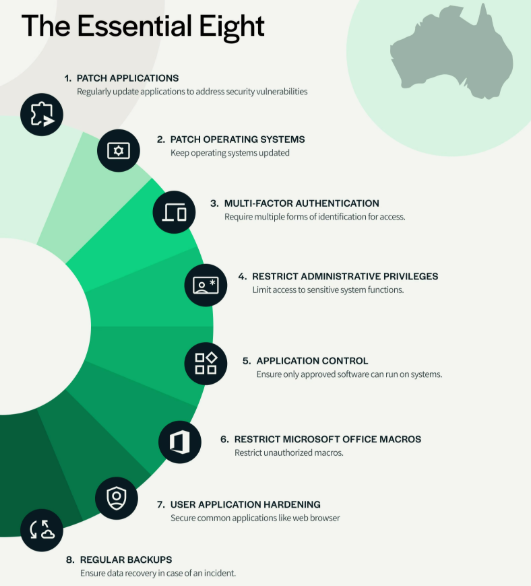
For executives, the objective is not to “tick eight boxes.” It is to reduce the probability and impact of ransomware and data loss, evidenced by measurable control performance. The Essential Eight covers:
- Application control
- Patch applications
- Configure Microsoft Office macro settings
- User application hardening
- Restrict administrative privileges
- Patch operating systems
- Multi-factor authentication (MFA)
- Regular backups
Maturity Levels range from 0 to 3. Level 2 is a common target for SMBs and public sector entities; Level 3 is ideal for higher risk environments and regulated sectors.
Staged uplift plan with timeframes and evidence
The sequence below aligns to risk reduction and speed to value. Timeframes are typical for mid-sized SMBs, councils, schools, and regional health services; actual effort varies by scale and legacy complexity.
Stage 1, 0 to 30 days, quick wins and high risk reduction
- MFA: Enforce for privileged accounts, remote access, and cloud apps. Evidence: identity platform policy exports, conditional access screenshots, and SOC sign-in risk reports showing blocked events.
- Admin privilege control: Remove standing domain admin rights, introduce just-in-time elevation. Evidence: group membership reports, privileged access management logs, and monthly access review sign-offs.
- Macro blocking: Block internet-sourced macros and disable unsigned macros. Evidence: Group Policy Objects (GPO) or MDM baselines, and SIEM detections for macro execution attempts.
- Backup isolation: Implement 3-2-1 with one immutable or offline copy and define a restore test cadence. Evidence: backup job configs, storage immutability settings, and documented restore test results.
Stage 2, 30 to 90 days, visibility and hygiene at scale
- Patch operating systems and applications to defined SLAs. Evidence: vulnerability management dashboards, patch compliance reports, and exceptions register.
- User application hardening: Disable Flash, web ads, and unnecessary browser plugins; enforce safe defaults. Evidence: configuration baselines, hardened browser policies, EDR telemetry.
- Application control pilots on high-risk systems. Evidence: allowlist policies, change control records, and incident tickets showing blocked executions.
Stage 3, 90 to 180 days, resilience and continuous monitoring
- Expand application control to server and workstation estates. Evidence: coverage metrics by business unit, exception approvals, and SOC alerts for policy violations.
- Full backup recovery drills including domain controller and critical clinical or student information systems. Evidence: runbooks, Recovery Time Objective (RTO) and Recovery Point Objective (RPO) results, and after-action reviews.
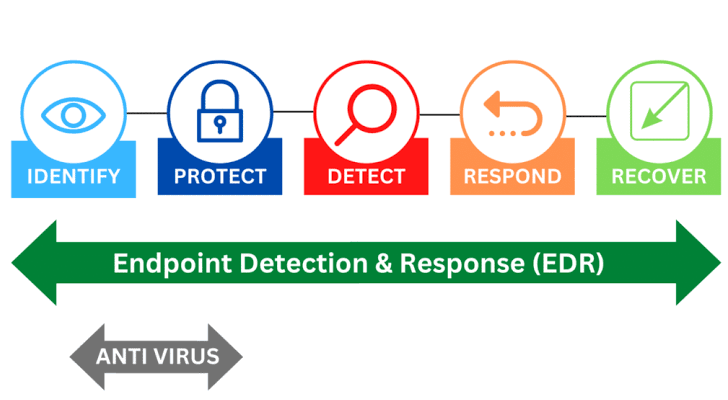
- Detection and response integration: EDR tuned to catch ransomware precursors, privilege misuse, and macro bypass attempts, with SIEM correlation. Evidence: use cases list, detection logic IDs, alert closure summaries and Mean Time to Detect (MTTD) and Mean Time to Respond (MTTR) trends.
Common pitfalls and how to close them
- Admin privilege creep: Over time, service accounts and temporary access become permanent. Close it with least privilege, periodic access reviews, PAM or just-in-time elevation, and SOC alerts on privilege changes.
- Patch latency: Without SLAs and accountability, critical updates linger. Close it with vulnerability management that prioritises by exploitability, maintenance windows, and patch success KPIs visible to the board.
- Inadequate backups: Backups that cannot be restored are not protection. Close it with immutable copies, network segmentation for backup infrastructure, credential separation, and scheduled, evidenced restore testing.
- Macro exposure: Partial GPOs leave gaps for roaming and Mac devices. Close it with identity conditional policies, device compliance checks, and EDR rules that flag Office spawning scripting engines.
A managed SOC with EDR, SIEM, vulnerability management, and disciplined backup strategy converts policy into outcomes. White Rook Cyber’s SOC correlates endpoint, identity, cloud, and email telemetry to detect real attacks quickly, then guides containment and recovery.
Sector nuances and typical timelines
- SMBs: Target Level 2 across all eight in 3 to 6 months. Dependencies are usually identity hygiene and patch process maturity.
- Councils: Multi-vendor estates and older line-of-business apps often slow application control. Plan for phased allowlisting and compensating controls under SOC oversight.
- Healthcare: Clinical systems and downtime constraints require staged patching and rigorous recovery drills. Prioritise MFA for remote access and immutable backups early.
- Schools: BYOD and mixed device fleets necessitate strong email and identity controls, macro blocking, and awareness training for staff and students.
Governance, Risk, and Compliance in context
Governance, Risk, and Compliance (GRC) is the integrated discipline that aligns security decisions to business objectives, manages cyber risk within appetite, and demonstrates compliance with obligations. Its pillars are:
- Governance: decision rights, policies, roles, and oversight.
- Risk management: identification, assessment, treatment, and monitoring of risks.
- Compliance: meeting laws, standards, and contractual requirements with evidence.
White Rook Cyber’s GRC audits map Essential Eight, ISO 27001, NIST, SMB1001, and DISP, producing gap analyses, prioritised roadmaps, and audit-ready evidence. If you need a structured starting point, book an Essential Eight maturity assessment to align uplift with budget and risk appetite.
DLP and the reality of “Essential Eight of DLP”
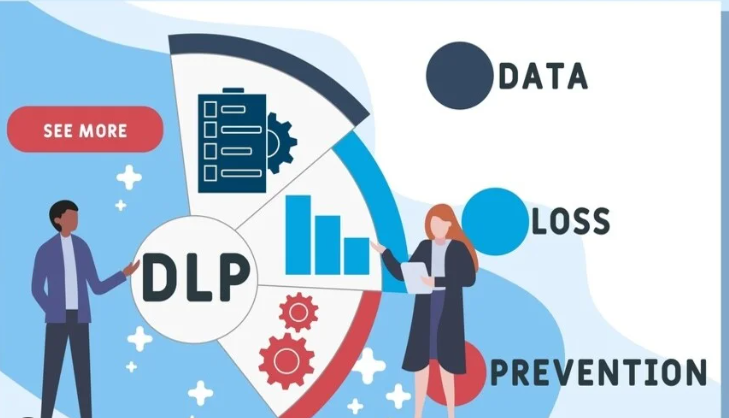
There is no separate “Essential Eight of Data Loss Prevention.” The term typically refers to the ACSC Essential Eight. For Data Loss Prevention, best practice combines policy, technology, and process:
- Classify data and apply policy-based controls at creation.
- Monitor channels, email, cloud apps, endpoints, and removable media.
- Use context plus content inspection, including pattern and fingerprinting.
- Integrate with identity and device posture for conditional actions.
- Educate users and test with realistic scenarios.
- Back it with incident workflows and metrics such as prevented exfiltration attempts.
DLP complements the Essential Eight by controlling sensitive data movement and strengthening recoverability through the 3-2-1 backup model with restore testing.
A board-ready Essential Eight dashboard
A simple, credible dashboard keeps focus on outcomes:
- Patch SLAs: percentage of critical OS patches within 14 days, and app patches within 30 days; exception count and ageing.
- MFA coverage: percentage of users and privileged accounts with MFA enforced; high-risk sign-in blocks.
- Macro protection: devices with internet-sourced macro blocking enabled; attempted macro executions blocked.
- Application control: endpoints under allowlisting policies; blocked unknown executions.
- Admin privilege: number of standing admins, approvals this month, and access review completion rate.
- Backups: success rate of nightly jobs, number of immutable copies, last full and item-level restore test results, and time to recover a critical system.
- Detection and response: MTTD and MTTR trends, incidents by tactic, and alert closure rate.
White Rook Cyber provides SOC and SIEM-backed reporting aligned to these metrics, giving executives reliable evidence for regulators and auditors.
How White Rook Cyber accelerates uplift
- GRC audits and Essential Eight assessments create a defensible baseline and roadmap.
- Blue Team uplift implements and tunes controls, from MFA and macro policies to application control and backup drills.
- SOC and SIEM monitoring with managed EDR and vulnerability management deliver continuous assurance.
- DLP and backup strategy enforce 3-2-1 with restore testing, while AI-driven phishing simulation and awareness training reduce human risk.
If you are planning budgets before EOFY, schedule a scoping call now to secure resources and lock in delivery windows.
Quick FAQ
- What is meant by Governance, Risk, and Compliance?
GRC is the coordinated approach to decision-making, risk management, and regulatory adherence that aligns security investments with business objectives and evidences compliance.
- What are the pillars of GRC?
Governance, risk management, and compliance, each with defined roles, processes, and evidence.
- What are the best practices for DLP?
Classify data, apply policy-driven controls across channels, use content and context inspection, integrate with identity and device posture, train users, and validate with incident workflows and metrics. Combine with 3-2-1 backups and restore testing to reduce impact.
- What is the Essential 8 of data loss prevention?
There is no separate Essential Eight for DLP. The Essential Eight is an ACSC framework for mitigating ransomware and common intrusions. DLP is a complementary control set focused on preventing unauthorised data movement.
Next steps and helpful resources
Book an Essential Eight maturity assessment to establish your baseline and receive an audit-ready roadmap before EOFY. For related uplift, explore:
- SOC and SIEM monitoring to operationalise detection and response: see our SOC services to understand how correlation and 24 by 7 oversight reduce risk at https://whiterook.dev.slnet.com.au/managed-services/soc-siem
- DLP and backup strategy that integrates 3-2-1 and restore testing: learn more at https://whiterook.dev.slnet.com.au/managed-services/data-loss-prevention
- AI-powered phishing simulation and awareness programs that reduce human risk: details at https://whiterook.dev.slnet.com.au/managed-services/phishing-simulation
- Managed awareness training to embed secure behaviours across staff: visit https://whiterook.dev.slnet.com.au/managed-services/awareness-training
Summary
The Essential Eight works when it is translated into clear controls, measurable evidence, and disciplined operations. Prioritise MFA, privilege reduction, patching, macro hardening, application control, and 3-2-1 backups with restore testing, then sustain performance with SOC-led monitoring, EDR, and vulnerability management. White Rook Cyber can baseline your maturity, deliver uplift, and provide the reporting your board needs. Schedule your assessment now to align delivery with EOFY budgets and demonstrate measurable risk reduction this quarter.